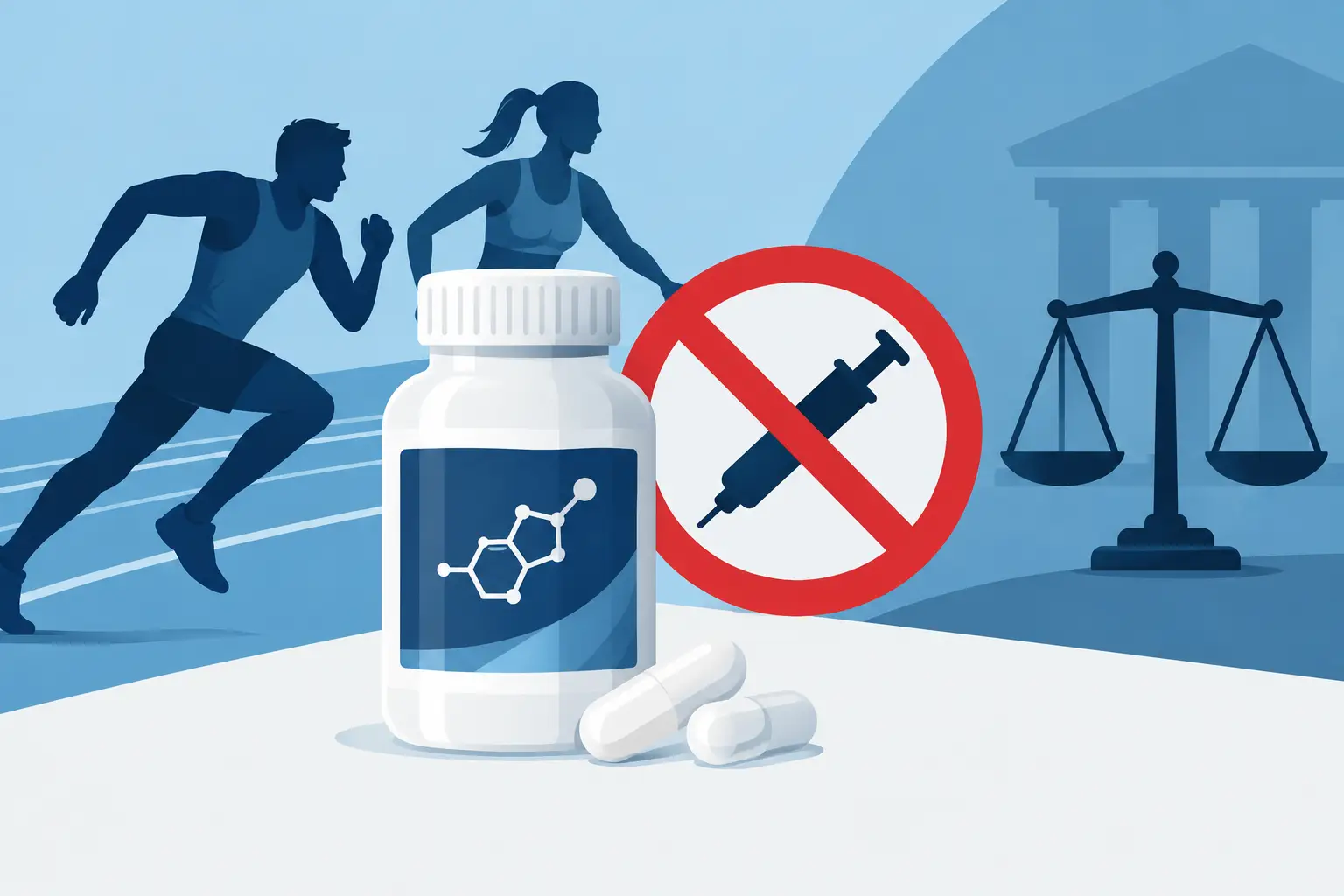
A hard training block, a physique goal or a better recovery plan does not change the one rule that matters in tested sport: you are responsible for what is in your system. So, is MK677 banned in sport? Yes. MK-677, also known as ibutamoren, is prohibited for athletes who are subject to World Anti-Doping Agency rules.
That answer is straightforward. The detail behind it matters just as much, particularly if you compete under UK Anti-Doping, a national governing body, a league, university sport or any event that applies WADA standards.
Is MK677 Banned in Sport Under WADA Rules?
Yes. Ibutamoren is listed in the WADA Prohibited List under S2, Peptide Hormones, Growth Factors, Related Substances and Mimetics. It is prohibited at all times, not only on competition day.
MK-677 is a ghrelin receptor agonist and growth hormone secretagogue. Put simply, it is used because it can stimulate the body’s release of growth hormone and influence related pathways, including IGF-1. That is exactly why it sits within an anti-doping category designed to cover substances that may alter growth, recovery and performance-related physiology.
The wording matters. A substance does not need to be an anabolic steroid to be banned. Anti-doping rules cover many categories: hormone modulators, stimulants, diuretics, peptide hormones and more. Looking only for the word “steroid” is a poor way to judge sporting risk.
For a tested athlete, the practical position is clear: MK-677 is not compatible with competing under WADA-compliant anti-doping rules.
Banned in Sport Is Not the Same as Illegal to Buy
People often mix up sporting rules, UK medicines law and product availability. They are separate questions.
A product may be available online and still be prohibited in tested competition. Equally, a substance can be banned in sport without being treated in the same way as a controlled drug. Sporting bodies set eligibility rules to protect fair competition and athlete health. They do not need a criminal-law ban before placing a substance on the Prohibited List.
This is where informed buyers need to be precise. If you do not compete in tested sport, the anti-doping rule itself may not apply to your daily life. But if you are registered with a governing body, play at a level where testing can occur, or may enter a tested event in future, the rule is directly relevant.
Do not assume that amateur status removes the issue. Testing is not restricted to elite professionals. Depending on the sport and competition, recreational, regional, student and masters athletes can all fall within an anti-doping framework.
Why the “Out of Competition” Detail Changes Everything
Some prohibited substances are banned only in competition. MK-677 is not one of them.
Because ibutamoren is prohibited at all times, using it in an off-season, during a bulk, while injured or months before a planned event can still create an anti-doping problem. There is no safe assumption that being outside a competition window makes it acceptable.
Athletes should also avoid trying to calculate a clearance date from forum posts or anecdotal claims. Detection, metabolism, testing methods, dose, duration of use and individual biology can vary. More importantly, anti-doping compliance is not a guessing game. Trying to time use around a test carries obvious sporting and reputational risk.
If your sport is tested, the sensible decision is not to use a substance prohibited at all times.
Strict Liability: The Rule Athletes Cannot Ignore
Anti-doping operates on a principle called strict liability. In plain English, the athlete is responsible for any prohibited substance found in their sample, whether it came from a named product, a poorly labelled product, contamination or bad advice.
Saying that you did not know MK-677 was prohibited is unlikely to remove the violation. Saying a coach, training partner or online seller told you it was fine is not a reliable defence either. Sanctions depend on the facts of a case, but a positive result can bring a ban, lost results, disqualification, financial damage and long-term harm to your reputation.
That risk goes beyond the substance named on a label. The broader performance-compound market has a long-standing transparency problem. Vague dosages, incomplete ingredient lists and cross-contamination can turn a poor purchasing decision into a serious issue for a tested athlete.
Clear labelling and consistent standards matter for every buyer. For athletes in a testing pool, though, even a clearly labelled MK-677 product still presents the same fundamental problem: ibutamoren itself is prohibited.
What to Do If You Compete or Might Compete
Start with the rules of your actual sport, not hearsay from the gym floor. National governing bodies, event organisers and professional leagues may all have their own processes, but many follow the WADA list or a closely aligned policy.
If you are taking anything for a genuine medical reason, speak with a qualified clinician and check the anti-doping requirements before competing. A Therapeutic Use Exemption can exist for certain necessary treatments, but it is not a blanket permission slip and should never be assumed. Ibutamoren is not an approved shortcut to recovery or body composition for a competing athlete.
It is also worth checking your position before signing up for an event rather than after. Some people move from untested gym goals into tested bodybuilding, combat sports, athletics or team sport without changing the approach they take to compounds. The switch can have consequences. Your eligibility is worth more than a short-term experiment.
Tested and untested sport are different decisions
There is a clear line between a person pursuing private fitness goals and an athlete bound by a tested competition rulebook. Neither group benefits from vague information, but they need to assess different risks.
For the tested athlete, MK-677 is a no. For the non-competing adult, the question becomes one of personal circumstances, product confidence, health considerations and understanding what they are choosing. Those are still decisions that deserve proper thought, not hype.
The Bottom Line for UK Athletes
MK-677 is banned in WADA-governed sport at all times. If you are tested, could be tested, or want to preserve the option of entering tested competition, do not treat ibutamoren as a grey area. It is not one.
The best time to check a substance is before it becomes part of your routine. If competitive sport matters to you, build your training, recovery and nutrition around choices you can stand behind when the rules are applied.