

A label can look convincing while telling you very little. If you want to know how to compare MK677 ingredients, focus less on front-label promises and more on the exact active compound, the stated quantity, the inactive ingredients and whether the seller can connect the product in your hand to a real batch record.
That is where the difference sits. In a category crowded with vague claims, clear information is not a bonus. It is the starting point.
Start with the exact active ingredient
MK-677 is commonly used to describe ibutamoren, often listed as ibutamoren mesylate. These terms should not be treated as interchangeable without context. A proper label should identify what is actually present, rather than relying only on the shorthand name “MK-677”.
Look for a full, unambiguous ingredient declaration. If the product uses ibutamoren mesylate, it should say so. If the listing only says “MK-677 complex”, “proprietary blend” or similar language, you have no clear way to establish what the active ingredient is or how much of it has been included.
Salt forms also matter when comparing labels. A quantity stated for a compound in one form may not be directly comparable with a quantity stated for the active component alone. This is exactly why a seller should explain its naming and quantities clearly, rather than expecting customers to fill in the gaps.
Avoid making decisions based on a product name, flavour, capsule colour or oversized claims. The ingredient panel is the part that counts.
Compare the stated amount, not the serving hype
Once you have identified the active ingredient, check how the amount is presented. Is it shown per capsule, per millilitre or per serving? Is the serving size clearly defined? Can you work out precisely what is in each unit without doing guesswork?
A transparent label gives you enough information to compare like for like. A vague one does not. For capsules, that means a stated quantity per capsule alongside the number of capsules in the tub. For liquids, it means a clear concentration and a sensible explanation of the measuring method.
Be wary of labels that lean heavily on “high strength” while avoiding a specific figure. Strength is a marketing word unless it is supported by the exact compound and quantity. The same applies to products that display a large number on the front but use tiny print to define a multi-unit serving on the back.
If two products appear similar but one is substantially cheaper, do not assume you have found the same product for less. First check the active form, amount per unit, total units and the evidence behind the label. Price only becomes meaningful after those points are clear.
How to compare MK677 ingredients beyond the active compound
The active ingredient gets most of the attention, but the rest of the formula still deserves a proper look. In capsule products, inactive ingredients may include the capsule shell, bulking agents, flow agents and anti-caking agents. In liquid products, they can include solvents, sweeteners, flavourings and preservatives.
These ingredients do not automatically make a product better or worse. They should simply be disclosed. The aim is to know what you are buying, particularly if you have sensitivities, dietary requirements or a preference for a simpler formula.
A capsule shell may be gelatine or vegetable cellulose. A liquid may contain alcohol, glycerol or another carrier. None of this should be hidden behind vague wording such as “other ingredients”. Clear labels name the ingredients and give you a realistic picture of the finished product.
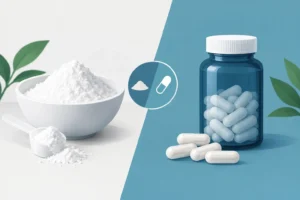
There is also a practical trade-off between product forms. Capsules are usually straightforward to count and carry, with fewer concerns around measuring. Liquids can make it easier to adjust the amount consumed, but they demand clear concentration details and a reliable measuring method. Neither format is automatically superior. The better choice is the one with a clear formula, sensible presentation and information you can verify.
Check whether the label can be tied to a batch
A batch number is one of the most useful trust signals in this category, but only when it means something. It should appear on the product packaging and correspond to supporting documentation from the same batch. A generic certificate that does not identify the tested batch offers limited reassurance.
Ask a simple question: does the seller have evidence for this product, or just a document that looks scientific? A credible batch record should identify the sample, batch or lot number, date and testing method. It should make clear what was tested and what the result was.
For an active compound, identity testing helps confirm that the expected compound was found. Assay or purity testing gives a view of how much of the expected compound is present. Depending on the form and manufacturing process, wider checks can include residual solvents, heavy metals or microbiological screening. The relevant tests vary, but vague statements such as “lab tested” are not enough on their own.
Do not confuse a certificate of analysis with a guarantee of suitability or safety. Testing has limits, and a document is only as useful as its connection to the actual product and batch. Still, a seller able to provide clear, batch-specific information is giving you far more to work with than one offering no traceability at all.
Watch for ingredient red flags
The clearest warning sign is a product that will not tell you exactly what it contains. That includes blends with no individual quantities, labels that omit the active form, and listings that use technical language without supplying meaningful detail.
Four other issues should make you pause:
- Different ingredient details between the website and the product label.
- No batch number, expiry information or basic storage guidance.
- Claims of exceptional purity with no matching batch evidence.
- Unusually low pricing that is not explained by a genuine offer, volume or direct UK stock.
None of these points proves a product is poor on its own. A printing error, packaging update or temporary promotion can happen. But when several warning signs appear together, the sensible move is to step back rather than trying to rationalise the gaps.
Separate quality information from marketing claims
A clean ingredient list and a batch test are useful quality signals. They are not permission to believe every performance claim attached to the product. In this market, sellers often blur the line between product transparency and promises about outcomes. Keep those questions separate.
First, ask whether the product appears to be accurately identified and properly labelled. Then consider whether the claims are measured, realistic and supported. If a seller cannot get the basics right – active ingredient, quantity, batch and formulation – grand claims should not rescue the decision.
It is also worth remembering that MK-677, or ibutamoren, is not a licensed medicine in the UK. Product quality and personal suitability are different questions. Existing health conditions, prescription medicines and individual risk factors can change the picture considerably. Anyone with concerns around blood glucose, fluid retention, sleep, appetite or medication interactions should speak with an appropriate healthcare professional rather than relying on online commentary.
Consider the seller as part of the comparison
Ingredient comparisons do not stop at the tub. A specialist seller should be able to answer direct questions about stock, labels, batch information and delivery without hiding behind generic responses. If the item is presented as UK stock, the fulfilment process should feel consistent with that claim.
This matters because accountability is easier when the supplier is clear about where it operates and how it handles orders. UK-held stock, tracked delivery and accessible customer support will not replace ingredient verification, but they reduce the usual uncertainty that comes with anonymous marketplaces and overseas listings.
At MK677 Direct UK, the focus is simple: clear product information, fair pricing and UK-based fulfilment. That is the standard worth looking for wherever you choose to buy. A specialist retailer should make comparison easier, not turn basic facts into a scavenger hunt.
A better way to make the final call
Before purchasing, put the competing products side by side and compare the same points in the same order: named active ingredient, active form, quantity per unit, full inactive ingredient list, batch details, supporting test information and final delivered price. This prevents the loudest marketing message from deciding the result.
There will be occasions where one product costs more because it has stronger traceability, clearer labelling or a better-controlled supply chain. There will also be occasions where a lower price is legitimate because the seller operates directly, holds domestic stock or runs a genuine promotion. The point is not to assume. It is to compare the evidence.
The right product should not require blind trust. It should give you enough straightforward information to make a clear-eyed decision, then leave you confident that what is on the label is what you intended to compare.


Pingback: Top Features of Reliable MK-677 Products – MK677 Direct UK
I’ve been playing here for a while now and the interface is super smooth. Definitely one of the best spots for gaming. Check out inyk777 for a great experience!
I really appreciate the transparency and the clean layout of the platform. It makes the whole gaming experience much more relaxing. Cheers to vnyt88 for the top-notch quality.
Really impressed with the bonus offers they have for new members. It gave me a great head start. If you are looking for value, give idharta328 a try.