
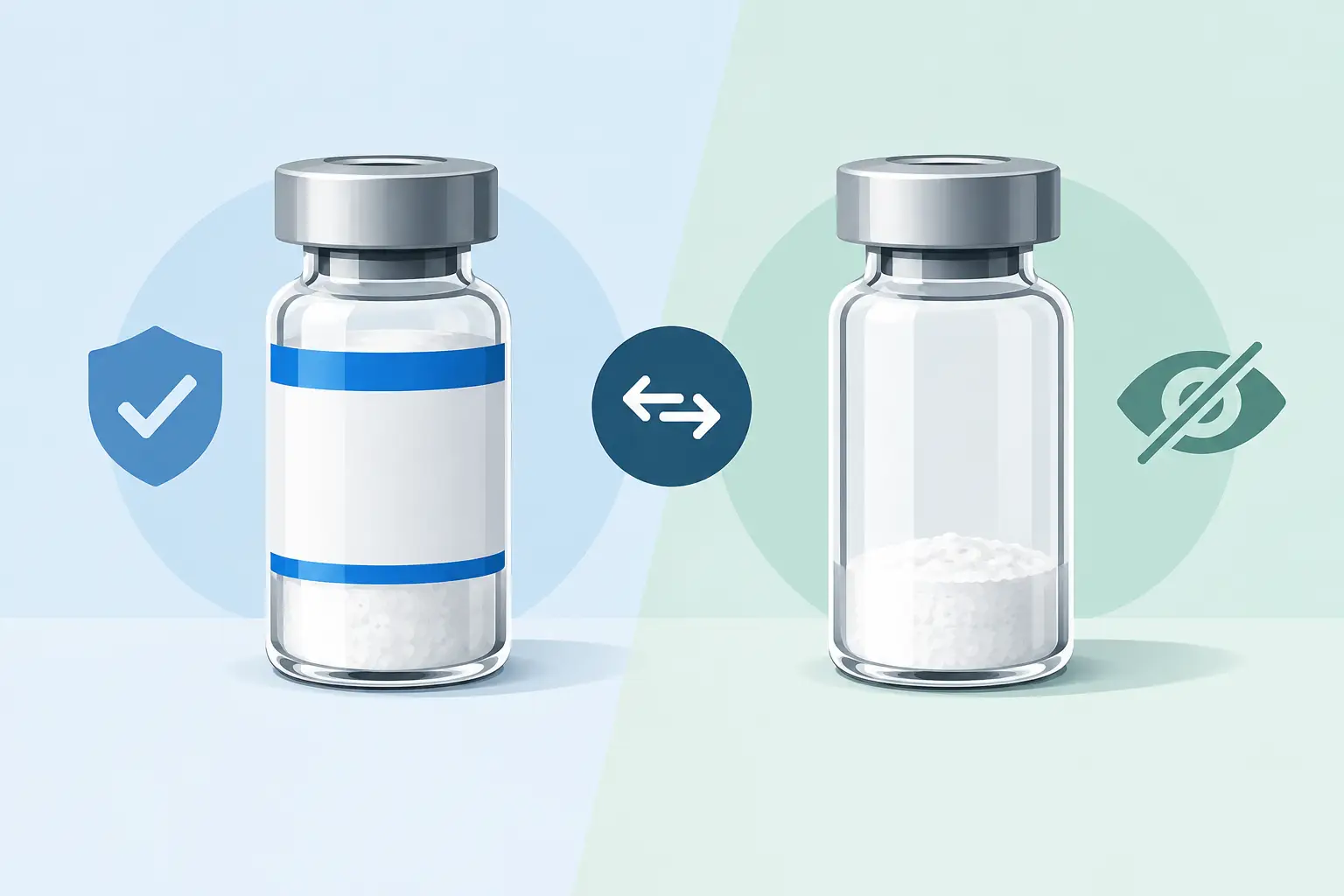
A plain bottle with a vague name might look discreet. It can also leave you with no meaningful way to identify what you have bought, compare it with a previous order, or question the seller if something is wrong. That is the real issue in the MK-677 labelled versus unlabelled conversation: not presentation for presentation’s sake, but basic product clarity.
For buyers who already know the category, a proper label is one of the quickest signs that a seller has put thought into consistency. It should help you establish what the product is represented to be, how much is supplied, and whether the item you receive matches the one you intended to order. It is not a magic guarantee of quality. But an unlabelled product asks you to accept far more uncertainty from the start.
MK-677 labelled versus unlabelled: the practical difference
A labelled MK-677 product gives you reference points. At a minimum, buyers should expect the product name, the stated amount or concentration, the format, and clear seller or batch identification where applicable. The label should be readable, specific and consistent with the product page and order confirmation.
That makes a difference after delivery, not just at checkout. If you order a liquid, for example, the concentration matters. If you order capsules or tablets, the stated amount per unit and quantity per container matter. Without that information, there is no sensible basis for comparing value, tracking use, or raising a query with the supplier.
An unlabelled bottle may contain something entirely different from what you expected. Equally, it may simply be a product supplied with poor documentation. The point is that you cannot tell. In a category where transparency is already variable, that is a weak position for the customer.
What a label should make clear
Good labelling is direct. It should not force customers to decode shorthand, rely on a social-media message, or guess from the size of a bottle. Look for an identifiable product name, the stated quantity, and enough detail to distinguish one item or batch from another.
For liquids, the concentration and total volume should be clear. For capsules and tablets, the stated amount per capsule or tablet, plus the number supplied, should be easy to find. Storage information and any relevant handling guidance also have a place where appropriate.
The seller’s details matter too. A specialist supplier with UK-held stock should be contactable and accountable for the product it sends. That does not mean every label needs to be crowded with marketing copy. It means the basics are there, in plain English, before and after the parcel arrives.
A label should also match the listing. If the website describes one format, concentration or quantity and the bottle says something else, stop and query it before relying on the product. Consistency across the product page, packaging and dispatch record is a far better signal than flashy design.
What a label cannot prove
This is where buyers need to stay level-headed. A professionally printed label does not independently confirm identity, purity, potency or safety. Labels can be copied. Claims can be overstated. A polished bottle is not a substitute for transparent business practices.
MK-677, also known as ibutamoren, is not an authorised medicine in the UK. It should not be treated as one, and product packaging should not make sweeping medical promises. Anyone considering it should understand the legal and health context, speak to an appropriately qualified healthcare professional where necessary, and avoid treating online product claims as medical advice.
There are potential risks and individual factors that a label cannot assess for you. Existing health conditions, medication use, personal tolerance and the reason you are considering the product all change the picture. If a seller makes the decision sound risk-free, that is not confidence. It is a reason to be cautious.
Why unlabelled products create avoidable problems
The immediate attraction of an unlabelled product is often price or perceived discretion. Neither fixes the underlying problem. If there is no stated concentration, unit amount or batch reference, you cannot make a like-for-like comparison with another option. A cheaper bottle may not be cheaper at all once you account for what is, or is not, actually disclosed.
It also makes repeat ordering difficult. Buyers who value consistency want to know that a reorder is comparable to the last product received. Clear packaging and stable product information give you a reference point. With an unlabelled item, every order becomes a fresh guess.
Then there is the issue of storage and mix-ups. An unmarked bottle can be confused with another liquid, another supplement, or something that should not be taken at all. Keep products in their original, clearly marked packaging and away from children and anyone who should not have access to them. Discretion should never come at the cost of basic identification.
A better way to assess a UK supplier
The smartest approach is to look beyond the label without dismissing it. Start with whether the product information is clear before you pay. Then assess whether the company is easy to identify, whether it holds and dispatches stock in the UK, and whether its pricing and product specifications remain consistent.
Tracked domestic delivery is useful here for practical reasons. It gives you a clearer dispatch trail and reduces the uncertainty that can come with anonymous overseas fulfilment. It is not evidence of product quality on its own, but it is part of a more accountable buying experience.
Pay attention to how the seller handles straightforward questions. Can they explain the format and stated amount without evasive wording? Do the details on the bottle align with the order? Are the terms, dispatch process and contact details clear? These are ordinary checks, but they separate a specialist operation from a seller that expects customers to take everything on trust.
At MK677 Direct UK, the focus is simple: clear product information, UK-held stock and tracked delivery, without the vague packaging and inconsistent experience that frustrate buyers in this category.
Questions worth asking before you order
Before choosing between products, ask whether you can identify exactly what is being offered from the listing alone. You should be able to see the stated format, amount or concentration, quantity and price without chasing details privately.
Next, ask what would happen if the delivered product did not match the description. A supplier should have a clear route for customer support and be prepared to deal with genuine order queries. If a business has no clear identity, no usable contact route and no meaningful packaging information, the lower price is rarely the bargain it appears to be.
Finally, be honest about what you need from the purchase. If certainty, repeatability and a clean record of what you ordered matter to you, an unlabelled product is working against those priorities. There is a difference between minimal packaging and absent information. The first can be practical. The second leaves the buyer carrying all of the risk.
The right standard is not a bottle covered in hype. It is clear, consistent information you can check before ordering and recognise when it lands at your door. That is the baseline that lets you buy with your eyes open.



I’ve tried a few platforms recently but this one is surprisingly smooth. The interface is intuitive and the payouts are fast. Definitely recommend checking out vnggk88 if you are looking for a reliable spot.